🏥 Hospital Service Robots: Logistics, Disinfection, and the Smart Hospital Roadmap
![신년특집] 대학병원이 요양병원에 파견하는 '만능 로봇' < 2023년 신년특집 < 기획·특집 < 기사본문 - 청년의사](https://www.docdocdoc.co.kr/news/photo/202301/3001693_3002158_1332.jpg)
Hospitals face a converging set of pressures: staffing shortages, exploding workloads, and tightening infection control standards. The response: robots that run errands, transport supplies, and disinfect spaces — freeing clinical staff to stay at the bedside.
The global medical service robot market is projected to grow from $20.59B (2024) to $52.0B by 2030. Hospital logistics AMRs are the fastest-growing segment within it; the disinfection robot market alone is forecast to grow at 19%+ annually from $3.6B (2023) through 2030.
🚚Hospital Logistics Robots: Running the Errands
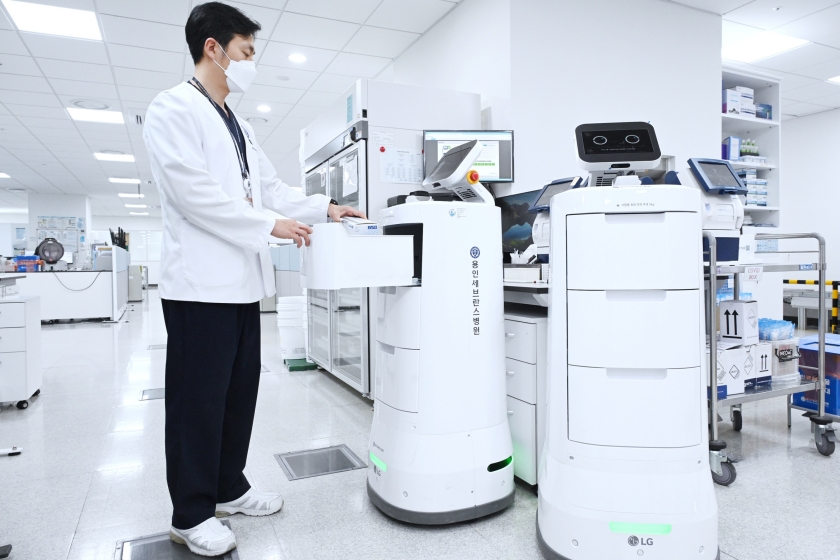
Diligent Robotics' Moxi — deployed in 25+ US hospitals — has logged over 1 million deliveries and 150 million steps on behalf of clinical staff. Hospital logistics robots handle three categories of work:
Medication, specimens, and consumables delivery
- Pharmacy ↔ ward: delivering prescribed medications
- Specimen lab ↔ testing lab: transporting blood, urine, and tissue samples
- Ward station restocking: replenishing gloves, gauze, syringes, and other high-turnover supplies
These routes are short but extremely frequent — the source of the common nursing complaint that "half the shift is just running errands."
Meals, linen, and environmental transport
- Delivering meal trays, water, and snacks to patient rooms; collecting used trays
- Distributing clean linen (sheets, towels, patient gowns) to wards
Robots handle the scheduled, repetitive route work; staff focus on patient assessment, room care, and direct communication.
Waste, laundry, and equipment transfer
- Moving infectious waste bags and boxes to designated collection points
- Transporting used linen and laundry to collection areas
- Relocating shared equipment between wards
Waste and laundry handling ranks among the tasks staff most want to avoid — infection risk, weight, odor, and travel distance all combine. Logistics robots simultaneously address the labor shortage and the infection exposure problem.
😷 Disinfection Robots: Mobile Sterilization
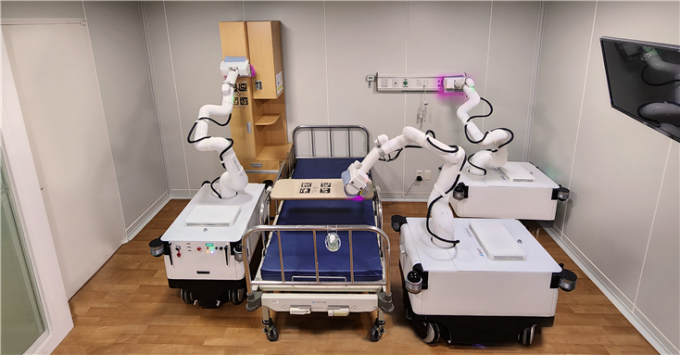
Post-pandemic, the disinfection robot market has become one of the fastest-growing segments in healthcare automation — projected at $1.3–3.6B (2023) growing at 19–20% CAGR through 2030, with hospitals and healthcare as the largest end-user segment.
UV disinfection robots
AMR platforms equipped with UV-C lamps autonomously navigate designated spaces — patient rooms, operating theaters, corridors, restrooms — sterilizing surfaces and air. Key advantage: robots can enter high-risk zones that staff prefer to avoid, and execute disinfection routinely without consuming human time.
Spray/mist disinfection robots
Atomizing or misting disinfectant for rapid large-area coverage. Effective for wide spaces but requires coordination with the infection control team to manage human exposure, residue, and ventilation requirements.
Both types offer a shared benefit: automated logging of disinfection records, travel routes, and cycle times — data the infection control team can use for compliance tracking and process improvement.
🧑⚕️ What Clinical Staff Actually Experience
Benefits
- Fewer repetitive errands: reduced cross-facility travel, with staff reporting lower physical and mental fatigue on night shifts
- Reduced infection exposure: fewer entries into isolation rooms and infectious waste zones
- More time at the bedside: Diligent Robotics reports Moxi has returned over 575,000 hours to clinical staff across 1M+ deliveries
New burdens
- New workflow rules needed: who requests robot tasks, when, and how
- New failure response protocols: who responds when a robot stalls or encounters an error
- In short: a robot is a new piece of equipment to manage — organizational and workflow design must accompany the hardware
Hospitals that deploy service robots successfully treat it as a process redesign project, not a hardware purchase.
☑️ Deployment Checklist
Building infrastructure
- Elevator compatibility: robot-callable, floor-selectable, door-interlocked?
- Corridor width: sufficient for robot, bed, and staff to pass simultaneously?
- Door types: automatic doors, fire doors, card-access zones — what's the robot's navigation boundary?
- Restricted zones: ICUs, isolation areas — how are exclusion zones defined and marked?
IT and systems integration
Hospital robots are almost entirely IT projects. Key integrations:
- EMR/HIS (electronic medical records / hospital information system)
- Pharmacy and specimen systems (LIS)
- Elevator and access control systems
- Notification systems (PDA, mobile app, call systems)
The level of integration determines what the robot can actually do. Without knowing the destination ward and station from the system, and without a defined notification protocol on arrival, delivery errors and idle robots result.
Workflow design
The core question: whose work, and how much of it, transfers to the robot?
- Who handles specimen transport — nurses, ward assistants, or the robot?
- What's the human-to-robot split for overnight amenity and meal delivery?
- How does the environmental services team's role change with disinfection robots?
Without predefined answers, the risk is a parallel operation where staff work at full load and robots sit idle.
🤖 The Smart Hospital Roadmap
The likely deployment sequence for most hospitals:
- Logistics robots first — automate repetitive delivery: medications, specimens, amenities
- Disinfection robots — expand to high-risk zones and high-frequency common areas
- Wayfinding and support robots — patient navigation, location guidance, basic information
- Robot + data integration — connect logistics and disinfection data with EMR and operations analytics for facility-wide efficiency and safety insights
In this picture, robots are not the protagonists — they are the circulatory system of the smart hospital, enabling clinical staff to spend more time where it matters most: with patients.
For risk assessment and safety design ahead of robot deployment, contact Safetics.