🏨 Hotel Service Robots: From Room Service Runner to Brand Asset
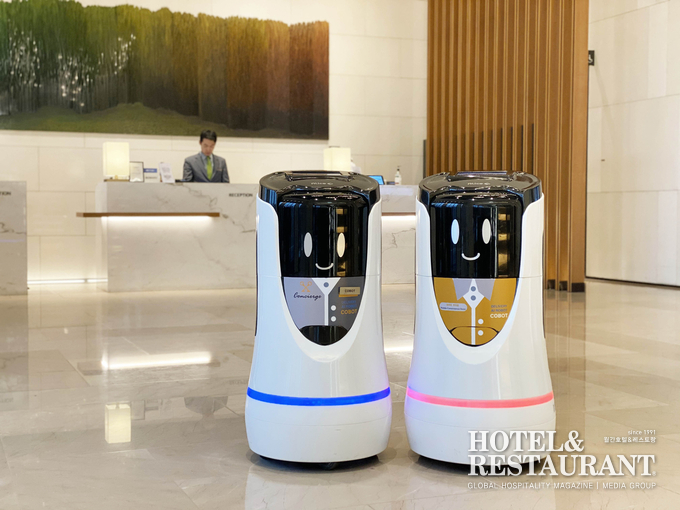
That compact cylindrical robot riding the elevator alone and chiming outside your door isn't a novelty anymore — it's a signal that the hotel service robot market has genuinely arrived. The global hotel lobby robot market is projected to grow from $1.35–1.5B (2024) to $8.9–9.5B by 2033; the broader hospitality robot market from $20.6B (2024) to $126.4B by 2035.
Three forces are driving adoption: chronic staffing shortages in housekeeping and night-shift roles; 24/7 service demand that doesn't pause at 2 AM; and post-pandemic guest preference for contactless service. The result: hotels are deploying robots not as guest-facing novelties, but as dedicated corridor runners replacing the staff member who used to walk the delivery.
🤖 What Hotel Service Robots Actually Do

Room service and amenity delivery
Relay — the market's best-known player, deployed across major US and global hotel chains — handles the full delivery loop autonomously: collecting items from the service station, calling the elevator, navigating to the guest room, sending an arrival notification, and waiting at the door. Marriott, Hilton, and Westin are among the chains now running these systems commercially. Peak value is on late-night and early-morning shifts, when front desk and room service staffing is minimal.
Food delivery pickup and drop-off
Some hotels use robots to handle the last leg of third-party food delivery: a delivery rider drops food at the lobby pickup zone; the robot carries it to the guest room. Additional amenity requests — water, slippers, humidifiers — follow the same flow.
Lobby navigation and brand experience
Information robots in lobbies provide local attraction guides, breakfast hours and restaurant locations, and "follow me" escort functions. Japan's Henn-na Hotel has deployed humanoid and dinosaur robots at check-in and concierge stations. This category leans more toward brand differentiation than operational efficiency — but the marketing value of the "robot hotel" concept is real, and some check-in and wayfinding tasks are genuinely automated in the process.
🤔 The Guest Experience
What guests appreciate:
- Contactless delivery — requesting items without answering the door in pajamas is a genuine comfort driver
- Low-friction late-night requests — asking a robot for water at 3 AM feels easier than calling the front desk
- Novelty factor — kids love it; "the robot hotel" generates positive reviews
What guests find frustrating:
- Complex requests don't translate — "two towels, one pair of slippers, and a firm pillow, please" still needs a human
- Technical failures — elevator connectivity issues and network interruptions remain a source of friction
Hotels that deploy successfully tend to split the workflow explicitly in the app or front desk UX: standard amenities and simple items → robot delivery; complex requests and complaints → staff.
🧐 Five Deployment Considerations
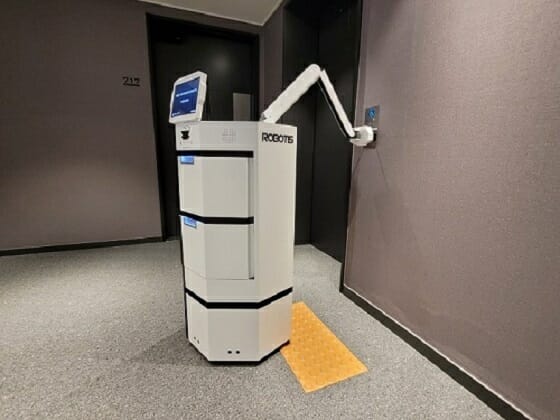
Building infrastructure
- Elevator compatibility: robot-callable, floor-selectable, door-interlocked?
- Corridor width: sufficient for robot and guest to pass simultaneously?
- Fire doors, auto-doors, card-access doors: what are the robot's navigation boundaries?
Skipping this check risks the scenario where the robot is purchased but has nowhere useful to go.
IT and systems integration
Ideal integrations: PMS (property management system) for room number and status data; in-room phone or app push for arrival notifications; door lock systems for access rules. Hotel service robots are IT projects as much as hardware purchases.
Task scoping — start narrow
Most successful deployments follow this sequence:
- Amenities first: water, towels, toiletries, disposables
- Simple room service: snacks, beverages
- Expand to app-ordered food pickup and beyond
Starting with standardized, repeatable requests minimizes failure risk before expanding scope.
Safety and security
- Speed and distance limits when encountering children, wheelchair users, and elderly guests
- Emergency protocols ensuring robots don't block corridors
- Liability framework for incidents involving guest belongings or privacy — requires advance agreement between hotel, robot vendor, and insurer
Brand experience
Hospitality is an experience business. Key questions:
- Does the robot fit the hotel's positioning (business, family, luxury, lifestyle)?
- What name, voice, screen UI, and tone of communication suits the brand?
- Is the narrative "a helpful colleague" rather than "a replacement for staff"?
Done well, the robot becomes a brand asset, not just a piece of equipment.
A hotel delivery robot is best understood as a dedicated corridor runner — not a guest-facing representative. For hotels considering deployment, three questions frame the decision: Is the building infrastructure robot-friendly? Which tasks transfer first? Is there organizational capacity to design the system, safety protocols, and brand experience together?
For risk assessment and safety design ahead of robot deployment, contact Safetics.