📦 Humanoid Robots in Factories & Warehouses: A Roundup of What They're Actually Doing Right Now
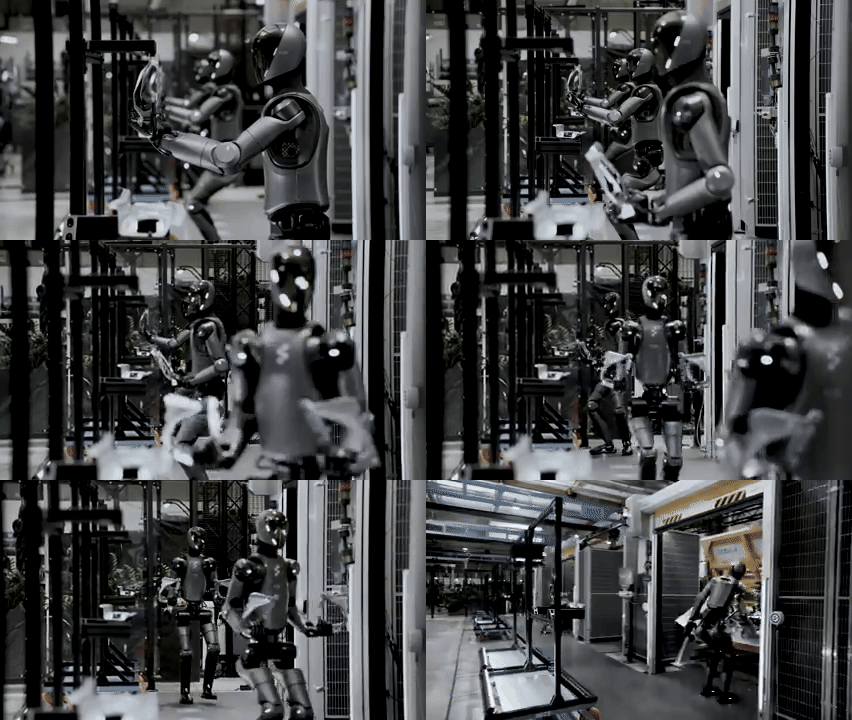
McKinsey and other research firms consistently show that humanoid robot commercial pilots are launching first in structured environments — warehouses and factories with mapped routes, defined workflows, and repetitive tasks.
Two drivers explain this: acute labor shortages in logistics and manufacturing (hundreds of thousands to millions of unfilled handling roles in the US alone), and a concentration of physically demanding, musculoskeletal-risk tasks that operators are eager to offload.
These facilities also already contain conveyors, autonomous mobile robots (AMRs), and other automation equipment — leaving human workers to fill the awkward gaps between islands of automation. That gap is exactly where humanoids are targeting their first foothold.
🤖 In the Warehouse: What Humanoids Are Doing
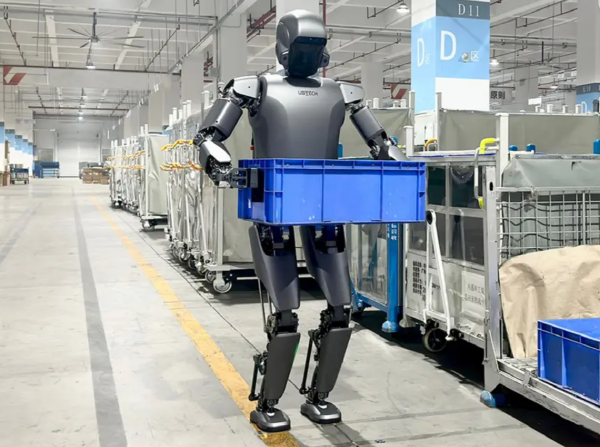
1. Transferring totes between AMRs and conveyors
The most frequently cited application. In GXO Logistics' pilot with Agility Robotics, the humanoid Digit picks up totes delivered by AMRs and places them onto conveyor belts. Amazon's pilot follows a similar structure, with Digit moving empty totes through the facility to maintain flow. In short: humanoids are beginning to serve as the "middle person" bridging AMRs and conveyors.
2. Palletizing & depalletizing
Agility Robotics' published skill library defines Digit's core role as palletizing and depalletizing boxes between pallets, racks, carts, AMRs, and conveyors — including truck loading and unloading assistance. Current capability covers neatly stacked, uniform boxes in defined patterns; mixed SKUs and irregular freight remain out of scope for now. Deployment is progressing incrementally, starting with "heavy but pattern-simple" loading and unloading tasks.
3. Sorting and collecting recyclables
GXO pilots feature additional humanoid vendors handling recycling sorting and collection — repetitive pick-and-carry tasks that are physically taxing but require minimal decision-making. The emerging logic: hand off the unglamorous peripheral tasks first, before tackling core processes.
4. Inventory patrol and inspection support
Still limited but widely cited as a near-term expansion area: walking mapped aisles to scan shelf labels and compare against inventory data, detecting misplaced or incorrectly stacked items, and checking safety fencing, warning signs, and emergency button areas — flagging anomalies to facility managers.
🏭On the Factory Floor: What Humanoids Are Doing
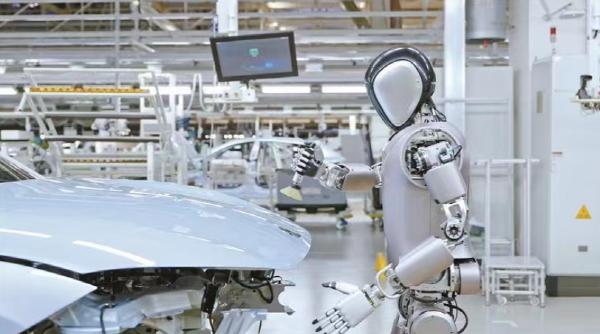
1. Parts delivery and line-side replenishment
Mercedes-Benz has taken an equity stake in Apptronik and is piloting Apollo in German and Hungarian plants for parts transport and quality inspection support. Figure AI's humanoid is similarly being piloted at a BMW plant in the US for logistics support — supplying and transporting components to production lines. The pattern: target physically demanding peripheral tasks around equipment rather than precision work inside it.
2. Basic quality inspection assistance
Mercedes-Benz also sees Apollo potential in simple inspection tasks: visually checking components and assemblies, scanning labels and serial numbers, and reading sensor data to classify pass/fail. Tedious for humans and prone to human error — well-suited to a humanoid executing a defined sequence reliably. Current humanoids still lag humans in speed, recognition accuracy, and handling edge cases, making "human + robot hybrid operation" the more accurate description than "full automation."
3. Tesla Optimus — Training for Factory Deployment
Optimus is not yet on a production line; it is rehearsing for one. Public footage shows box moving and sorting, table wiping, and repetitive handling drills. Tesla engineers perform motions directly — carrying objects, demonstrating sequences — generating training data for Optimus. The target: start with repetitive box and parts handling and simple workstation-side tasks, then expand incrementally.
🦾 Four Task Profiles Where Humanoids Fit Best Today
Profile | Examples |
|---|---|
Heavy but low-judgment handling | Moving 10–20 kg boxes from point A to B |
Short, defined transport routes | AMR dock → conveyor; parts rack → production line |
Bridging automation islands | Filling human gaps between conveyors, shuttle racks, AMRs, and AGVs |
High physical burden, repetitive tasks | Pallet loading/unloading, line-side replenishment, rack picking |
🚫 Three Task Profiles Still Too Difficult for Humanoids
Profile | Reason |
|---|---|
High-precision assembly | Fine manipulation, torque control, micro-adjustment — cobots + fixtures still superior |
High-speed, high-mix order picking | Hundreds to thousands of SKUs, dynamic environments — too fast and variable |
Unstructured, cluttered spaces | Uneven floors, dense obstacles, mixed human/vehicle traffic — bipedal safety risk too high |
Current pilots consistently reflect the same constraint: structured zones, defined motions, limited roles.
Candidate Task Checklist: Is Your Facility Ready?
Even without an immediate deployment plan, start identifying candidate tasks now:
✅ Is there a "middle person" role bridging AMRs, conveyors, and automation equipment?
✅ Are workers moving 10–20 kg boxes repetitively throughout the shift?
✅ Are there simple A↔B transport routes with high physical burden?
✅ Are there residual manual tasks that cobots and AMRs don't fully cover — doors to open, stairs in the path, mandatory human touchpoints?
The more items checked, the more likely a given process becomes a humanoid pilot candidate within three to five years. The shift is starting small — box by box, task by task — but it is already underway in warehouses and plants nearby.
For risk assessment and safety design ahead of robot deployment, contact Safetics.