🏥 From Frying Chicken to Transporting Specimens: Cobots Have Entered Everyday Life
Robots are no longer confined to factories. They are now frying chicken, delivering medications, stocking convenience store shelves, and transporting hospital specimens — integrated into the spaces of daily life.
The common thread: collaborative robots (cobots) designed to work alongside people, valued in healthcare, food service, and retail for their flexibility and safety in variable, human-occupied environments.
🏢 Five Real-World Deployments

bhc Chicken — Twibot (Korea)
Developed jointly with LG Electronics and rolled out to select stores from 2024, Twibot handles the full frying cycle: submerging raw chicken, timing the cook, and automatically lifting it out.
Staff fatigue from sustained exposure to high-temperature oil has dropped significantly; frying consistency has improved; and during peak hours — when human throughput hits its ceiling — the robot maintains a steady production rate, improving overall store operational stability.
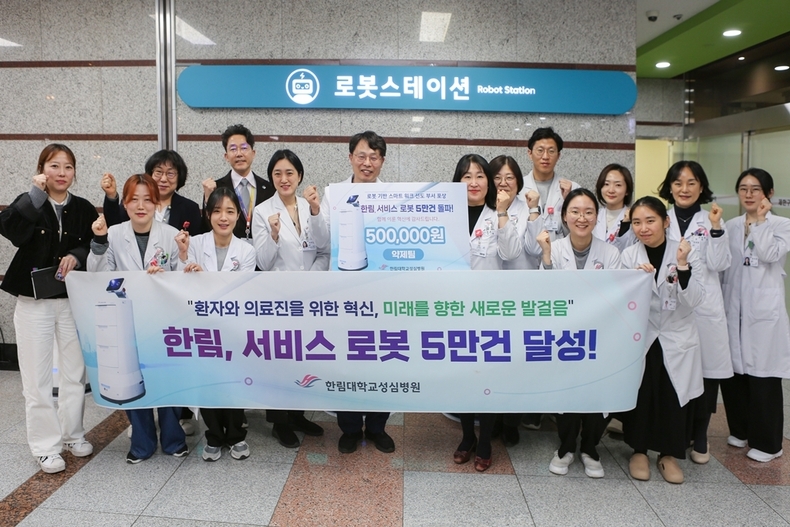
Hallym University Sacred Heart Hospital — 77 Medical Service Robots (Korea)
Since 2022, the hospital has deployed 77 medical service robots across medication and specimen delivery, patient navigation, and infectious specimen transport. The flagship Yakje Narumi (medication delivery robot) navigates autonomously along designated routes from the pharmacy to wards.
By 2024, it had completed over 50,000 cumulative tasks; over 90% of nursing staff reported a measurable reduction in workload. Clinical staff freed from repetitive transport tasks report more time for direct patient care, with measurable improvements in overall service satisfaction.
White Castle — Flippy 2 (USA)
The US hamburger chain deployed Flippy 2 for automated frying operations. The robot identifies the fryer basket, cooks fries for the defined duration, removes them, and portions them to spec. A two-person frying station now runs with one supervisor; drive-through order processing time improved by 15–25%.
Flippy also monitors oil change cycles, cooking temperatures, and inventory levels — extending its function from cooking automation to data-driven store operations.
FamilyMart Japan — Automated Beverage Stocking
From 2022, FamilyMart piloted Telexistence's TX SCARA robot for refrigerated beverage restocking across 300 stores. The robot scans shelf positions and inventory status, then retrieves and places items automatically.
Staff redirect to customer service and checkout; the deployment addresses Japan's chronic convenience store labor shortage. Notably, the robot is supplied via a Robot-as-a-Service (RaaS) model — monthly fee, no upfront capital cost — making it accessible without large initial investment.
Medical City Healthcare — Moxi (USA)
The US hospital network began deploying Moxi autonomous delivery cobots in 2020. Moxi calculates its own routes to transport supplies, specimens, and medical equipment between wards.
By 2023, it had completed over 400,000 cumulative deliveries — equivalent to approximately 200,000 nursing hours recovered. On-site staff describe it as "a reliable colleague that works around the clock."
🌍 The Pattern Across All Five Cases
Cobots handle repetitive, physically demanding, or hazardous tasks; people focus on customer interaction, clinical judgment, and higher-value work. This division — not replacement, but role clarity — is the healthiest form of automation these deployments demonstrate.
The next expansion wave: hotels, elder care facilities, schools, and retail — environments where the same logic applies and where labor constraints are equally acute.
For risk assessment and safety design ahead of robot deployment, contact Safetics.