🏭 Cobot Deployments in the Automotive Industry
Automotive manufacturing demands zero-tolerance precision across dozens of components assembled in a defined sequence. The shift to EV production has intensified this — high-voltage battery assembly and electronics inspection add physically burdensome, highly repetitive tasks to already demanding lines.
Where large industrial robots once handled simple repetition behind fencing, cobots now work alongside people: offering the repeatability and precision of a robot with the flexibility to share a workspace.
Three factors are driving adoption: simultaneous demands for repeatability and precision; ergonomic risk reduction needs; and the flexibility to adjust production volumes without retooling entire lines.
🏢 Five Real-World Cases
1. Hyundai Motor Group — Conveyorless EV Factory (Singapore)
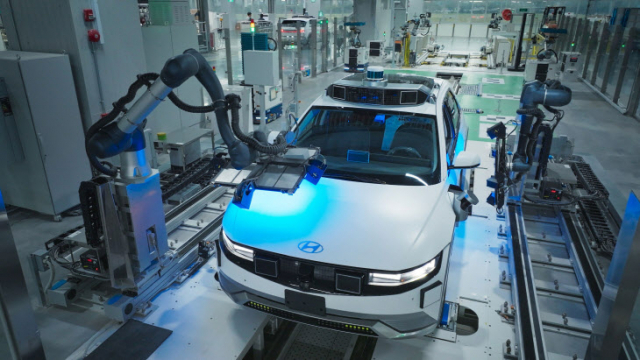
HMGICS (Hyundai Motor Group Innovation Center Singapore), completed in 2023, eliminated the conveyor belt entirely. Instead, workers and cobots share individual production cells, each handling multiple assembly and inspection tasks. Cobots perform seat function testing, transmission installation, wheel bolt fastening, and body quality inspection — while workers focus on tasks requiring adaptive judgment. Cell-based production enables rapid model changeovers. Deployed systems include Doosan Robotics H-series cobots, Universal Robots (UR), and AI vision-integrated inspection on select lines.
2. Hyundai Motor & Kia — ADAS Inspection in 85 Seconds
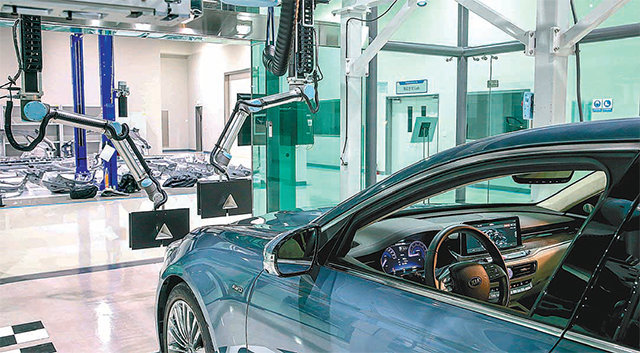
Since 2018, Hyundai and Kia have deployed a six-cobot system at Ulsan and other plants to inspect six Advanced Driver Assistance System (ADAS) functions simultaneously in under 85 seconds per vehicle.
Previously, each function — forward collision warning, lane departure warning, blind-spot monitoring, smart cruise control, HUD, and surround-view monitor — required separate manual inspection, with results varying by inspector skill level. The cobot system directly operates ADAS interfaces and analyzes output signals to detect malfunctions autonomously, reducing both inspection time and critical quality escapes.
3. BMW — Door Seal Film Application (Spartanburg, USA)
BMW's Spartanburg plant became the first European automaker to deploy a fence-free collaborative robot system in volume production. The application: attaching waterproof and soundproof polyethylene film inside door panels. Manual roller application produced uneven pressure, adhesion failures, and air bubbles.
The solution: workers position the film; a UR10 cobot applies controlled, sensor-regulated roller pressure for uniform adhesion every time. Worker fatigue dropped; quality consistency improved. The system has since been expanded to multiple BMW assembly lines.
4. Volkswagen — Underbody Bolt Fastening (Wolfsburg, Germany)
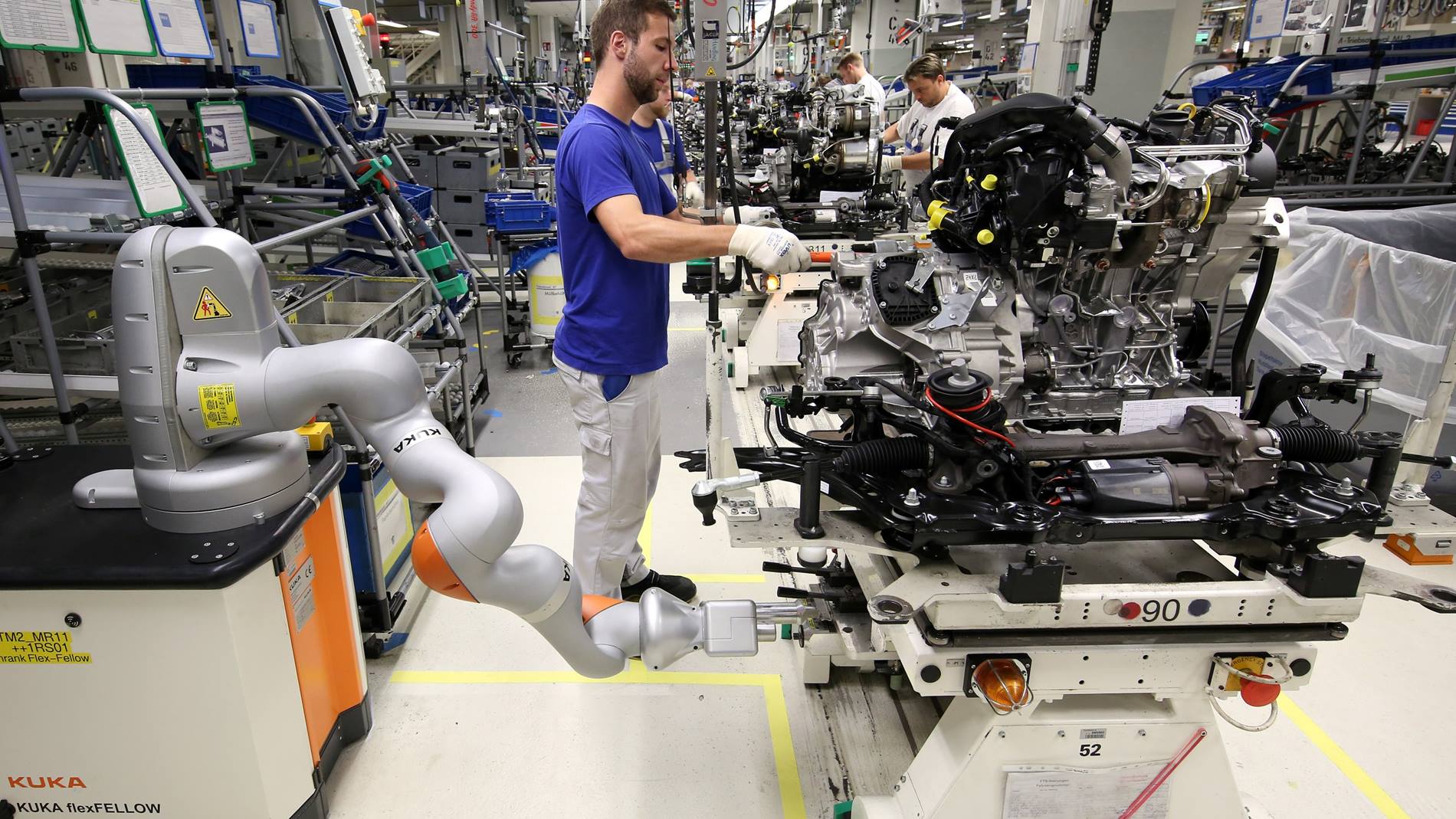
At Wolfsburg, drivetrain assembly required workers to fasten bolts in crouched or kneeling positions — a high musculoskeletal-risk task. Volkswagen deployed KUKA's flexFELLOW system: a mobile cobot platform (mobile base + LBR iiwa cobot) that enters the assembly cell when needed and relocates to another cell within 10 minutes when done.
The cobot handles precision fastening in low-access positions; workers focus on more complex assembly. Fence-free operation and rapid redeployment led Volkswagen to describe it as "the ideal collaboration model where humans and robots each maximize their strengths."
5. Ford — Pre-Paint Body Sanding (Europe)
Ford deployed six UR10e cobots at a European plant to sand and de-dust vehicle body surfaces immediately before painting — a process directly tied to paint quality, but prone to human pressure inconsistency and repetitive strain injury.
Each cobot is fitted with a 3D-printed end-effector that distributes pressure similarly to a human hand, reaching roof surfaces and other difficult areas with consistent force. One vehicle body is completed in 35 seconds. Workers focus on quality verification and finishing; both productivity and paint quality have improved.
🔧 The New Standard
From Hyundai's flexible production cells to BMW and Ford's precision finishing processes, these cases share a clear pattern:
- Cobots own repeatability, precision, and physical endurance
- Workers own adaptive judgment, exception handling, and complex assembly
Robots deliver productivity and consistency; people deliver flexibility and creativity. This role division is becoming the structural foundation of competitive automotive manufacturing — underpinning product quality, worker safety, line flexibility, and energy efficiency simultaneously.
For risk assessment and safety design ahead of robot deployment, contact Safetics.