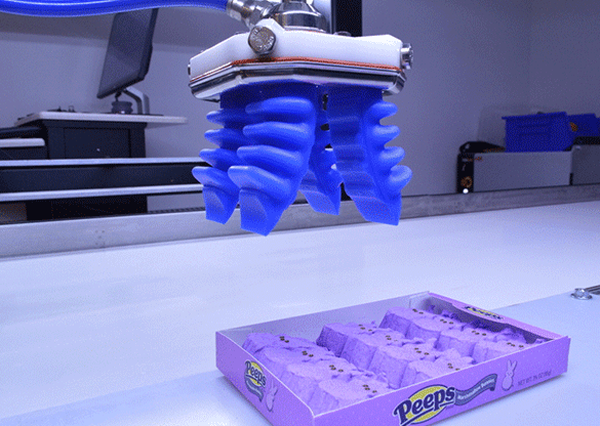
Rigid metal grippers have long dominated robotic end-effector design — but their limitations are well-documented. Irregular shapes, fragile surfaces, and variable packaging defeat conventional grippers, causing product damage and handling failures. Soft grippers address this directly: made from flexible silicone or polymer materials, actuated by pneumatics or vacuum, they conform to object geometry like a human hand, handling diverse shapes and materials without damage.

How Soft Grippers Work
The defining characteristics are flexibility and safety. Where rigid grippers require consistent object geometry, soft grippers self-adapt to irregular or deformable products. Impact forces are absorbed by the compliant material rather than transmitted to the object — reducing damage risk and making soft grippers inherently suited to collaborative robot (cobot) environments where human-robot proximity is the norm. Distributed contact pressure further reduces surface damage on sensitive products.
Industry Applications
Food
The highest-adoption sector. Fruit sorting — apples, strawberries, peaches — involves products with variable size, shape, and fragile surfaces that rigid grippers consistently damage. Soft grippers handle fruit without marking or bruising, and extend to baked goods and cakes on packaging lines. The combination of hygiene and quality preservation is driving rapid F&B adoption.
Logistics
Fulfillment centers process enormous volumes of items varying in size, weight, and packaging format daily. Rigid grippers handle uniform boxes efficiently but fail on irregular shapes and flexible packaging. Soft grippers wrap around varied geometries autonomously, improving picking speed and reducing damage rates. Major e-commerce operators are deploying soft grippers to improve picking efficiency at scale.
Electronics
Semiconductor packaging and smartphone component assembly involve small, precision, impact-sensitive parts where micron-level errors produce defects. Soft grippers provide stable grip with fine-grained control — handling sensitive components safely while reducing assembly defect rates. Several electronics manufacturers have reported measurable quality improvements following deployment.
Healthcare
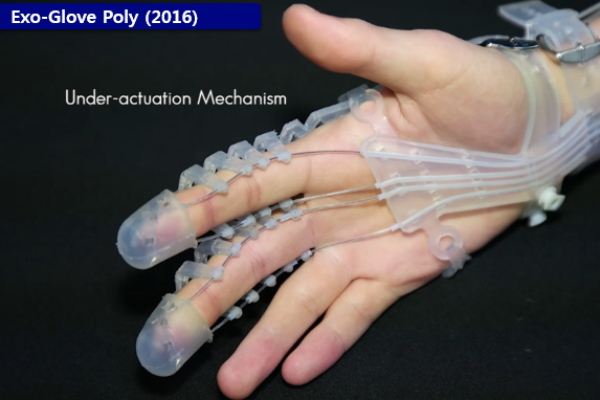
Surgical-assist and rehabilitation robots require the same compliance and gentleness as human hands when contacting patient tissue. Soft grippers move with human-hand-like flexibility, holding tissue without damage. In rehabilitation robots, they support patient limbs gently through training motions — enabling patient-friendly therapeutic environments.
Market Outlook

The global soft gripper market was valued at approximately $678M in 2024, with a forecast CAGR of 35.1% through 2034. Growth drivers include expanding cobot adoption, smart manufacturing and high-mix low-volume production trends, and ESG-driven manufacturing priorities — all of which favor flexible, safe, damage-minimizing handling technology.
Deployment Considerations
Soft grippers are not universal solutions. Key limitations to evaluate:
- Durability — flexible materials degrade under sustained high-cycle operation
- Control complexity — precise handling of diverse objects requires sophisticated control algorithms
- Initial cost — higher upfront investment than conventional rigid grippers requires rigorous ROI analysis
Working with a qualified robot system integrator (SI) to match gripper specifications to the actual production environment is essential before committing to deployment.
Soft Innovation
Soft grippers have moved from laboratory concept to proven industrial tool — active across food, logistics, electronics, and healthcare, and expanding. In a manufacturing landscape increasingly defined by product variety, fragile materials, and human-robot collaboration, the ability to handle objects gently and adaptively is becoming a core competitive capability. The soft gripper's role in smart manufacturing will only grow.
For risk assessment and safety design ahead of robot deployment, contact Safetics.