
Traditional robots followed fixed programs and stopped or errored when the environment changed even slightly. Machine learning and deep learning have given robots something new: situational judgment. Today's AI robot doesn't just execute commands — it understands its environment from data and finds the optimal approach autonomously.
Four Core Technologies
These four capabilities form an integrated "brain system" — not isolated functions, but interconnected layers of intelligence.
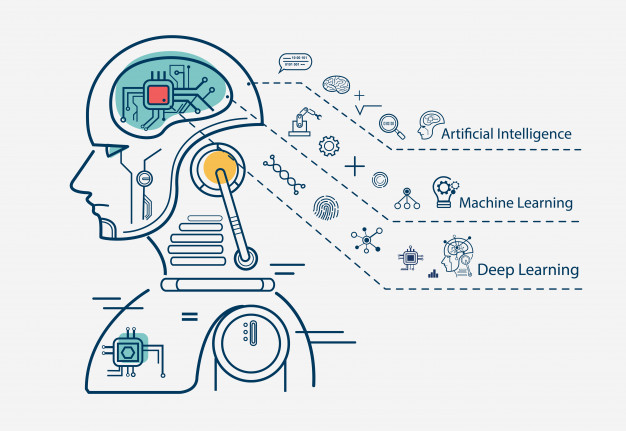
Machine Learning — Learning from Experience
Robots collect data from sensors, cameras, and motion logs, identify patterns, and apply them to improve subsequent performance — without requiring manual code updates. A welding robot that initially produces uneven beads learns from hundreds of cycles to deliver consistent, precise welds. An assembly robot reorders component sequencing based on cycle time and defect rate data to improve output quality.

Computer Vision — The Robot's Eyes
AI algorithms analyze camera, LiDAR, and 3D scanner data to classify objects, extract features, and make work decisions. Applications: detecting sub-micron scratches on semiconductor wafers invisible to the human eye; packaging robots reading barcodes and labels to auto-sort products. AI-integrated vision now handles non-uniform objects that earlier rule-based systems could not recognize.
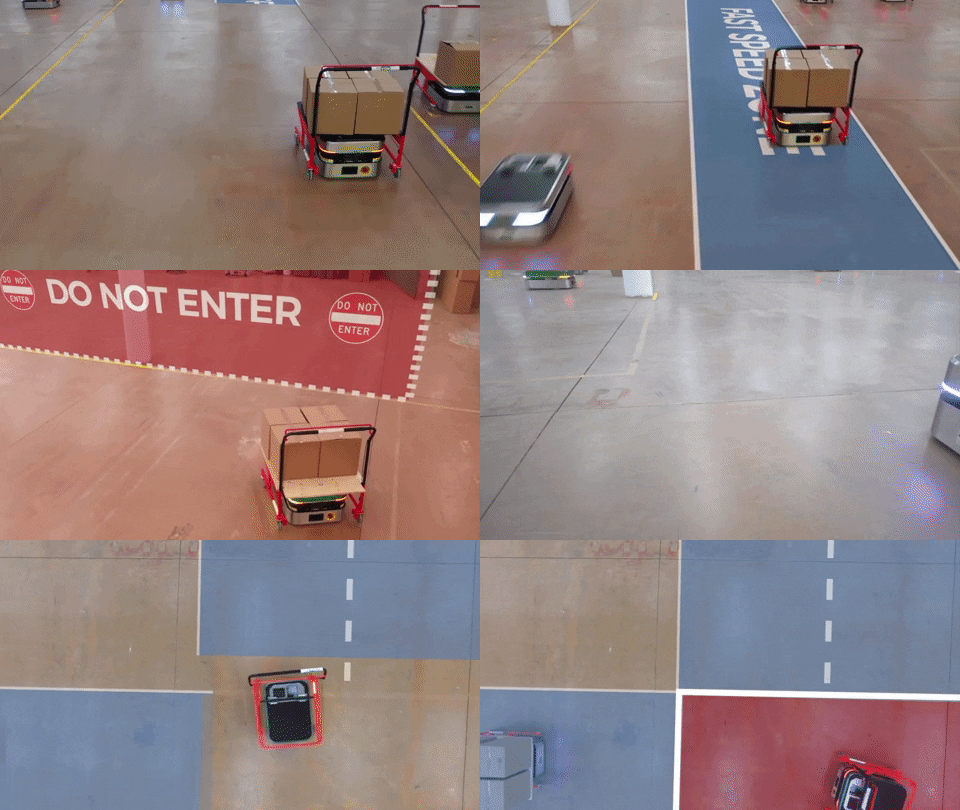
Path Planning — Autonomous Navigation
Robots generate real-time maps using SLAM (Simultaneous Localization and Mapping), analyze obstacle density, and calculate minimum-distance, minimum-energy routes automatically. AGVs in fulfillment centers optimize pick sequences based on inventory location and worker traffic; service robots navigate crowded café environments smoothly around people.
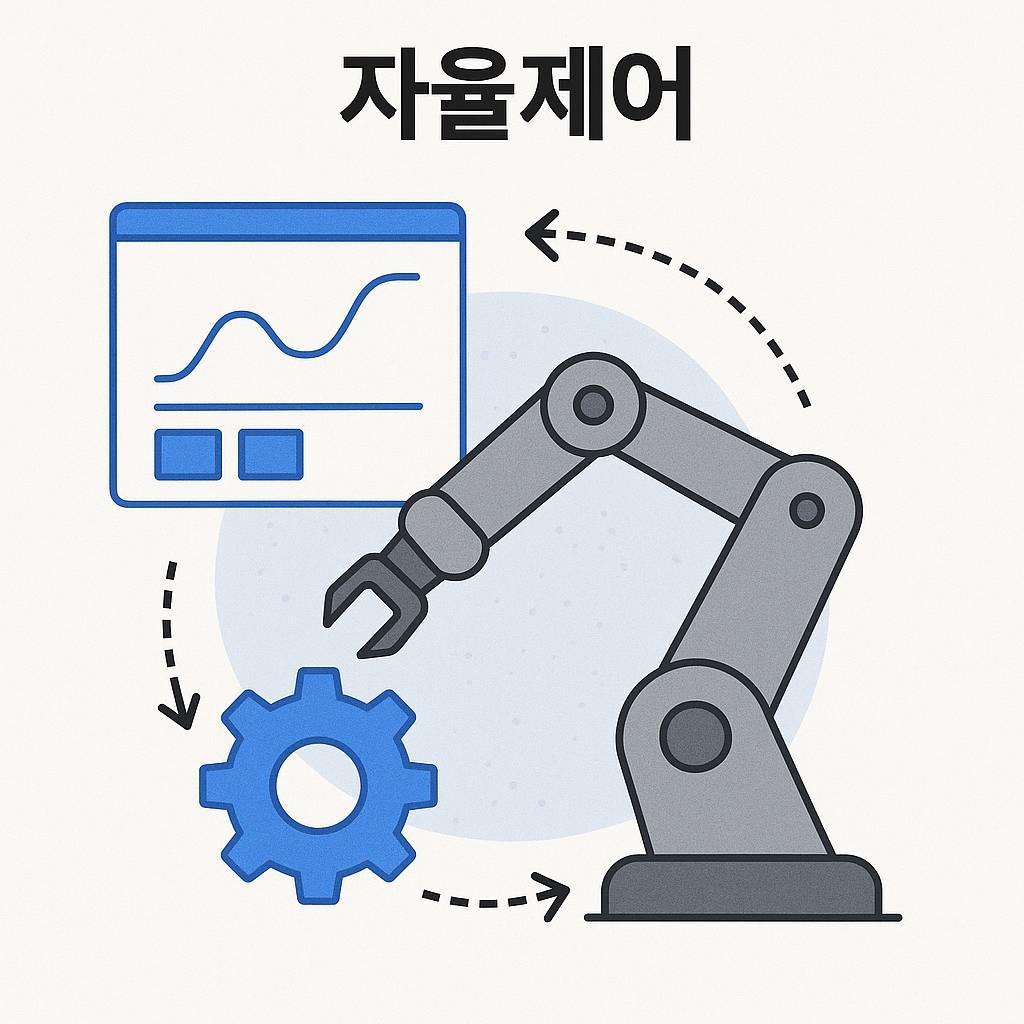
Autonomous Control — Real-Time Decision-Making
AI synthesizes sensor, vision, and machine learning outputs to assess the current situation, reprioritize, and modify the motion plan in real time. An assembly robot whose parts supply is delayed switches to an alternative task rather than idling; a service robot detecting an unexpected obstacle selects a detour route immediately. Downtime is minimized; production efficiency is sustained through variability.
Industry Applications
Industry | AI Robot Role | Key Outcomes |
|---|---|---|
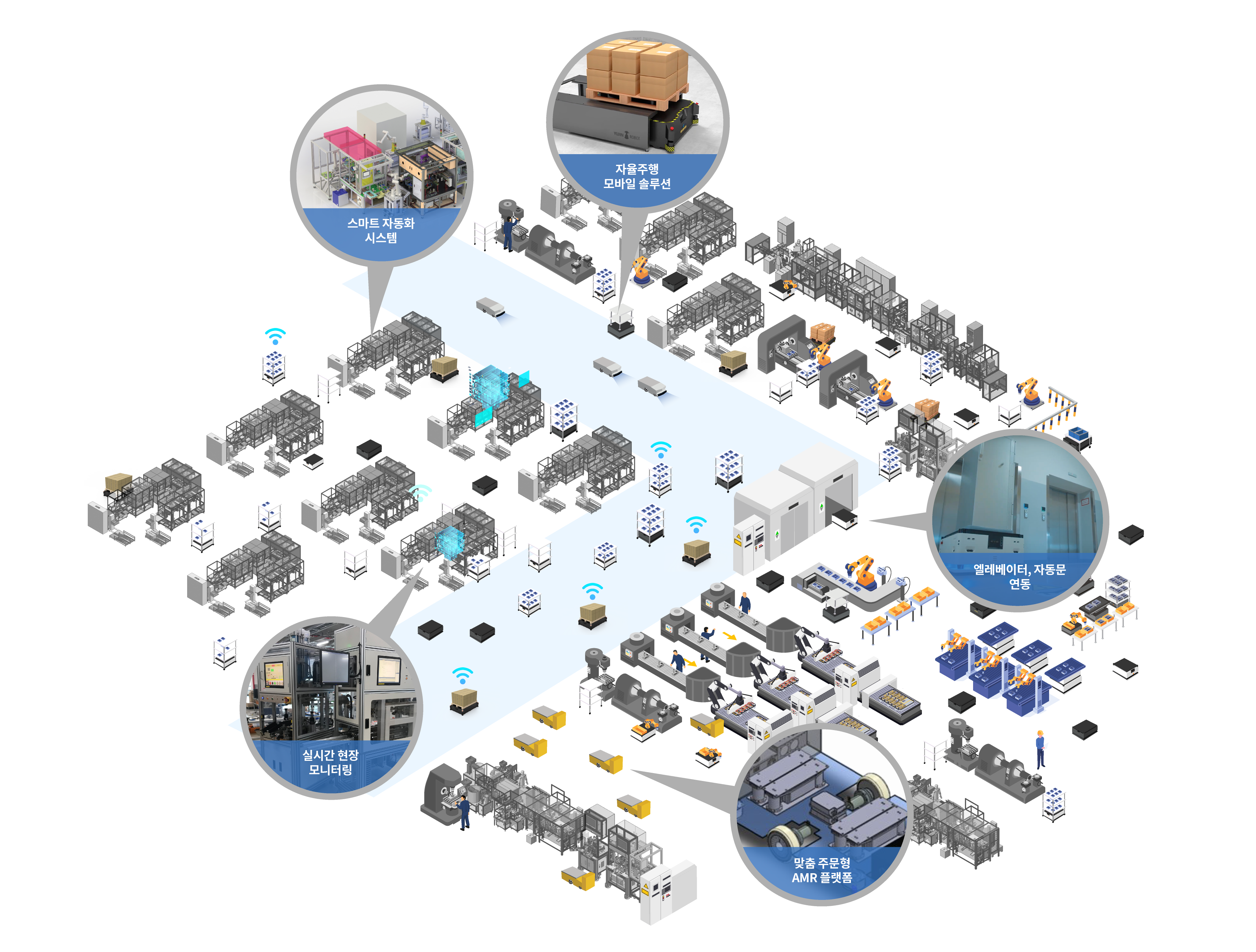
Manufacturing | AI vision-based defect detection; ML-driven precision improvement; predictive maintenance | Defect rate reduction; inspection speed doubled; downtime cut |
Logistics | Real-time AMR/AGV path optimization; AI demand forecasting | Faster order processing; lower error rates; peak-period bottleneck reduction |
Service | Human detection and avoidance; order queue analysis; facial and voice recognition | Optimized service routing; personalized guest interaction |
Agriculture | Crop condition analysis via vision + ML; harvest timing prediction; pest detection | Selective harvesting of ripe produce; early disease intervention |
Summary in one line per sector: manufacturing → quality and efficiency; logistics → speed and accuracy; service → customer experience; agriculture → quality and prediction.
Safety Standards and Risk Management
AI capability alone is not sufficient for industrial deployment — safety must be verified. In human-robot shared workspaces, international standards compliance is mandatory:
- ISO 10218 — foundational safety requirements for industrial robots: installation, operation, and maintenance guidelines
- ISO/TS 15066 — collaborative robot safety: permissible contact forces and pressures, speed limits during human-robot interaction
Risk management checklist:
- Hazard zone analysis — pre-map robot motion envelope, travel routes, and work environment to identify latent risks
- Safety technology — LiDAR, 3D vision, and safety mats for speed reduction or stop on human approach; PFL mode for safe collaboration without fencing or sensors
- Emergency stop — hardware buttons or software controls enabling immediate robot stop by floor workers
- Ongoing verification — safety behavior validation required after every AI model update
Key Deployment Considerations
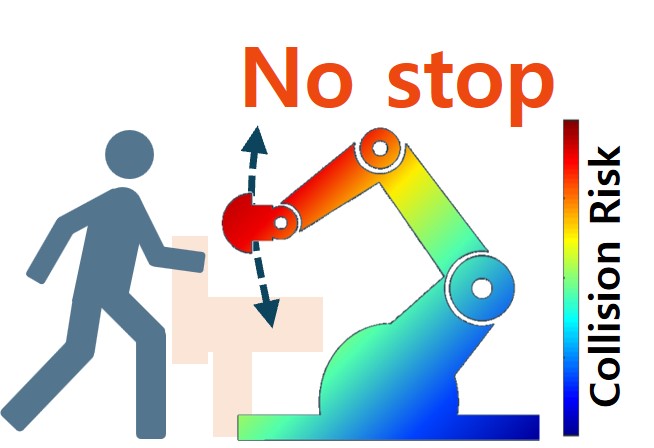
- Data infrastructure — high-quality training data acquisition is a prerequisite for effective AI learning
- Adaptation period — allow time for AI models to learn and stabilize in the actual production environment
- Regulatory compliance — system design must reflect applicable national and industry-specific safety regulations
- Safety design — workspace configuration enabling safe human-robot collaboration: fencing, sensors, or PFL as appropriate
AI robots are evolving into collaborative partners capable of real-time data analysis and autonomous decision-making — not just automation equipment. The next competitive frontier is robot safety intelligence: the ability for humans and robots to share the same space safely, without fencing or sensors. Safetics supports this future — enabling fence-free, sensor-free human-robot coexistence through verified safety design.
For risk assessment and safety design ahead of robot deployment, contact Safetics.