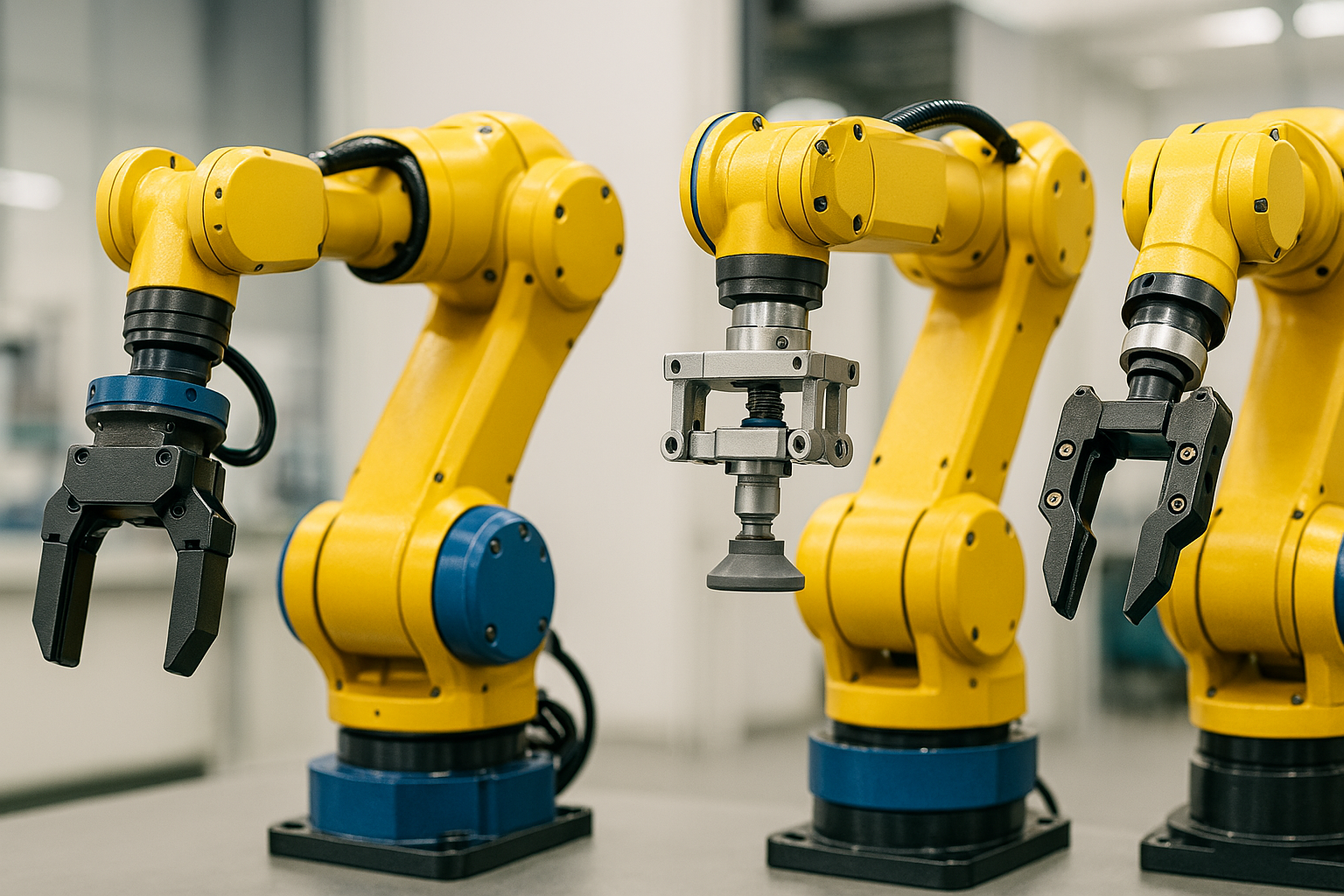
The gripper is the robot's hand — and choosing the wrong one undermines everything else. The right end-effector match directly determines production efficiency, defect rates, and system reliability. Here's what you need to know.
🛠️ Five Gripper Types

🦾 Mechanical Gripper
Metal or plastic fingers clamp objects from both sides, driven by pneumatic or electric actuation. Suited to: automotive component assembly lines, metal workpiece transfer, electronic component tray handling. Key advantage: stable grip on varied shapes and weights; capable of precision manipulation.
🌀 Vacuum Gripper
Suction cup pads generate negative pressure to adhere to object surfaces. Multiple pads enable handling of large surface areas. Suited to: electronics box packaging, glass panel transfer, food tray automated loading. Key advantage: high speed, high repeatability, no compression on the object — minimal damage risk.
🧲 Magnetic Gripper
Electromagnets or permanent magnets lift ferrous metal objects. Electromagnets allow one-touch release. Suited to: steel sheet stacking and transfer, CNC post-process part retrieval, scrap metal sorting. Key advantage: non-contact, no surface damage, handles thin or heavy metal objects easily.

🍩 Soft Gripper
Silicone or rubber fingers wrap around objects gently under pneumatic actuation. Suited to: fruit packaging lines, pharmaceutical vial handling, bakery product transfer. Key advantage: handles irregular or delicate products without damage.
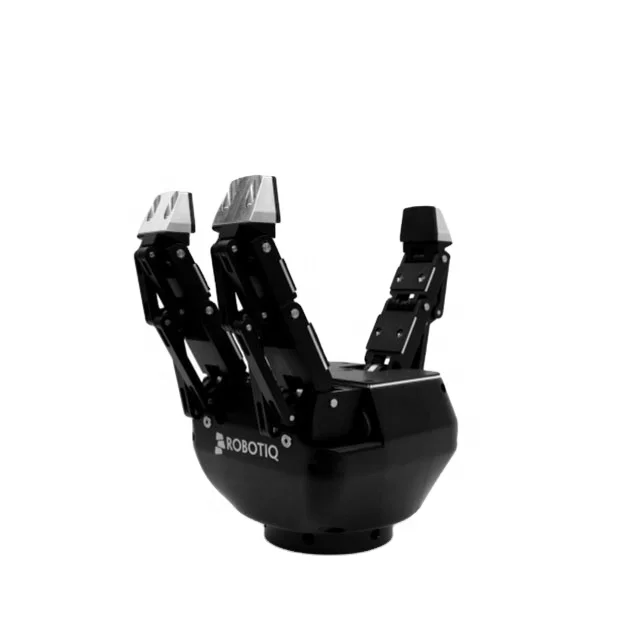
🧠 Adaptive Gripper (Multi-Joint)
Multiple articulated fingers conform to object geometry dynamically; AI-based control enables intelligent task execution. Suited to: cobot-based precision assembly, irregular part pick-up, retail product shelving. Key advantage: automatic adaptation to varied object forms; safe for human-robot collaboration.
👷 Gripper by Application
Application | Recommended Gripper |
|---|---|
Pick-and-place (flat surfaces) | Vacuum |
Pick-and-place (varied shapes) | Mechanical or adaptive |
Packaging (boxes) | Vacuum |
Metal part handling | Magnetic or mechanical |
Fragile or precision assembly | Soft or adaptive |
High-mix or irregular objects | Adaptive or mechanical + sensor control |
🍯Five Selection Criteria
- Payload — never exceed rated load capacity; account for fatigue under repeated cycling, not just peak load
- Surface material — vacuum grippers require smooth surfaces; rough or irregular surfaces suit mechanical or soft grippers
- Cycle time — short cycles demand fast-response grippers; pneumatic actuation typically outperforms electric on response speed
- Work environment — high temperature, humidity, or dust requires appropriate IP-rated protection; food and pharmaceutical lines require hygienic-grade materials
- Hybrid configurations — mechanical + vacuum combinations are increasingly common, offering flexibility across varied process demands
😎 The Bottom Line
그Gripper selection is not a minor procurement decision — it determines how intelligently the robot can execute its task. If the choice isn't clear, consult a robot system integrator (SI) to identify the optimal configuration for your specific process.
For safe and productive robot deployment, contact Safetics.