![젠슨 황 "로봇의 챗GPT 순간 온다" [CES 2025] - 파이낸셜뉴스](https://image.fnnews.com/resource/media/image/2025/01/07/202501071916580818_l.jpg)
NVIDIA CEO Jensen Huang's CES 2025 keynote declared the era of "Physical AI" — predicting that robots will gain AI brains, and AI will gain robot bodies. The convergence is accelerating: AI with physical understanding, robots capable of emotional interaction with humans. The question is no longer whether this future arrives, but when.
Software Alone Is Worth $1.5B

Skilled AI, a US AI robotics startup founded in 2023, achieved a $1.5B valuation with zero revenue — on the strength of its robot software alone. SoftBank and Amazon are investors. The company is developing scalable foundation models that enable diverse robots to interact safely and efficiently with humans in real-world environments — a universal "brain" for robots across hardware platforms.

In Korea, Samsung Electronics exercised a call option to become the largest shareholder of Rainbow Robotics; LG Electronics responded by acquiring management control of Bear Robotics. The pattern is consistent globally: as AI startup valuations have surged, robotics is widely identified as the next growth frontier — and capital is moving accordingly.
Big Tech Enters the Robot Body

OpenAI dissolved its robotics team in 2021. By 2024, it was collaborating with Figure AI on Figure 02 and is now evaluating development of its own humanoid robot — signaling a strategic expansion from AI software into hardware.

Google DeepMind developed RT-2, a model enabling robots to understand natural language instructions and act on them physically.

Meta is actively entering humanoid development.
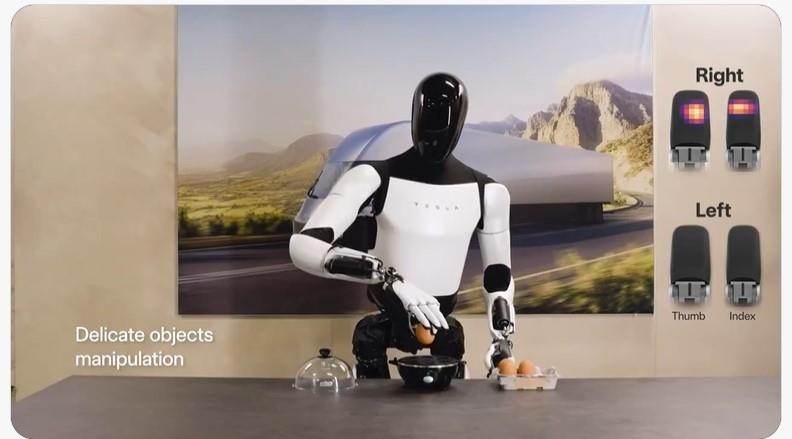
Tesla executed a major restructuring in early 2024, then aggressively hired AI and robotics talent in the second half — with at least 30 open roles tied to the Optimus humanoid. Elon Musk has publicly stated that Optimus could drive Tesla's market capitalization to $25 trillion. The company's identity is shifting from EV manufacturer to AI and robotics company.
The central concept behind this convergence is Artificial General Intelligence (AGI) — AI capable of human-like reasoning and autonomous learning across domains. Jensen Huang has stated AGI is five years away.
Safetics: World-First Robot Safety Intelligence

For those for whom AGI-powered humanoids doing household chores still feels distant, collaborative robots offer the nearest practical example of human-robot coexistence today.

Safety is more critical to robot adoption than technology. Safetics has developed SafetyDesigner — a web-based software implementing robot safety intelligence that enables robots to autonomously determine safe operating parameters. It predicts forces and pressures generated during human-robot contact, assesses risk level, and calculates the maximum safe speed at which the robot can operate alongside humans without stopping.

Key capabilities:
- Process design — library-based layout configuration
- Simulation-based collision verification — automated pass/fail collision analysis against international standards
- Risk assessment report — mandatory documentation for safety certification, auto-generated

SafetyDesigner provides end-to-end support for robot deployment — from design through legal safety compliance.
For safe and productive robot deployment, contact Safetics.